The Telangana government released the results of the largest Socio-Economic-Educational-Employment-Political and Caste (SEEEPC) Survey 2024 on 15 April 2026. This survey has become a new example for the entire country. In this, data of about 97 percent population of the state i.e. more than 3.55 crore people and 1.12 crore families was collected by going door-to-door. The survey was started on 6 November 2024, completed in 50 days and additional information was collected for two months. A total of 42 different parameters like income, education, employment, water and toilets were measured across 242 caste groups. But what will the government do with this survey? Know in the explainer…
Question 1: What is the exact percentage of different classes and castes in the total population of Telangana?
answer: The Independent Expert Working Group (IEWG) has revealed the layers of this data. In the report of this group, the average backwardness index (CBI) of the state has come out to be 81. According to the survey, the total population of the state is about 3.55 crore. In this:
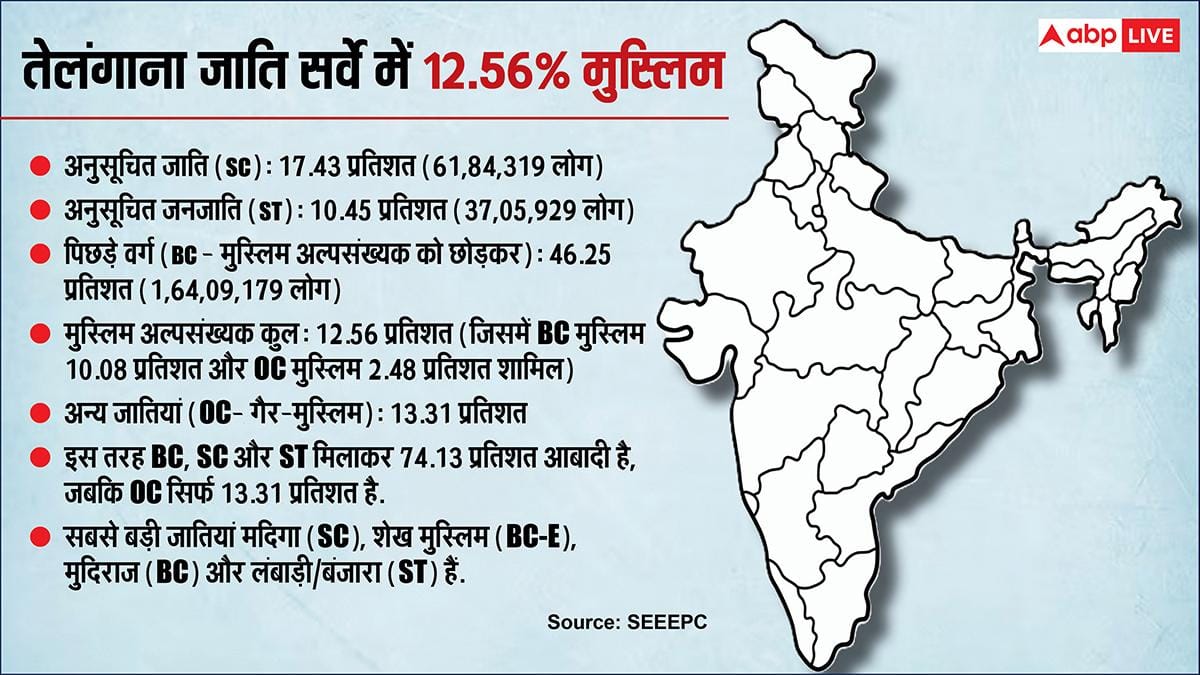
In this way, BC, SC and ST together constitute 74.13 percent of the population, while OC is only 13.31 percent. The largest castes are Madiga (SC), Shaikh Muslim (BC-E), Mudiraj (BC) and Lambadi/Banjara (ST).
According to the caste survey, 11,96,482 people (3.4 percent of the total population) chose the option of ‘no caste’. This number has become the 10th largest community in the state. Almost more than half of these people have caste certificates. These are used for welfare schemes, jobs and education. These people mostly live in urban areas, especially around Greater Hyderabad. This group comes among the least backward groups in the state. Their level of education and income is high.
Their share is 7.7 percent in government jobs, 13.3 percent in private jobs, 22.9 percent in IAS and IPS, 13.2 percent in other central government posts and 9.3 percent in judiciary. This clearly shows that the decision to give up the caste label is mainly more common among the educated, well-income and urban people.
Question 2: How deep is the backwardness in the state?
answer: Out of total 242 castes, 135 castes are more backward than the state’s average CBI score (81). These 135 castes cover 67 percent of the state’s population. These include 69 BC castes, 41 SC groups and 25 ST castes. SC and ST classes are three times more backward than the General Class (OC). BC class is 2.7 times more backward than OC. There is very little availability of education, employment, houses, clean water, toilets and health facilities among these 135 castes. People live in small, crowded houses, have less land, take loans from moneylenders at expensive interest rates and get trapped in the debt trap.
IEWG has derived category-wise CBI scores:
- SC Category Score: 96
- ST category score: 95
- BC class score: 86
- OC (Ordinary Category) Score: 31
The most backward SC sub-caste ‘Dakkal’ has a CBI score of 116, while the least backward Kapu caste has a score of only 12. The report clearly states that ‘not every backward caste is equally backward.’ This is the first time this has been proven with data. 135 castes are more backward than the average, while the remaining 107 castes are less backward than the average.

Question 3: What is the difference in income status between different classes?
answer: The annual income of 88.2 percent SC families and 86.2 percent ST families is less than Rs 1 lakh. In the general category (OC) this number is 56.2 percent. Overall, the income of 78 percent backward families is less than Rs 1 lakh. Whereas in OC families, the income of 13 percent is between Rs 5 lakh to Rs 50 lakh.
Among SC-ST, there are only 2.1 percent who earn more than Rs 5 lakh. Even among families with similar income (less than Rs 1 lakh), the CBI score of SC families is 49, while that of OC families is only 16. This means that even if the income is equal, backwardness remains due to caste.
Question 4: What changes has Telangana made in education and what is the difference between classes?
answer: After becoming a separate state in 2014, the government invested heavily in the English medium. Under the ‘Mana Vooru Mana Bari’ scheme, digital classrooms, toilets, drinking water and teacher training were provided in schools. The result is that 60.5 percent of children aged 6 to 29 years are now studying through English medium, while only 35.3 percent are studying in Telugu medium. This change is more rapid in cities and high-income families. 33 percent of general category children go to private schools, while less than 10 percent of SC/ST children.
Question 5: What is the status of employment, credit and basic facilities?
answer: Only 43.4 percent of the total population is in active employment.
- In SC, 50 percent people are daily wage laborers, whereas in OC, only 10 percent are.
- Private sector jobs in ST are only 5 percent.
- 44.4 percent families have at least one loan.
- Most loans are taken for farming, marriage, treatment and education.
- In rural areas, 56.7 percent of loans are related to agriculture.
- 6.8 percent people take loans from moneylenders.
- The rate of taking loan for treatment in SC families is 16.2 percent.
- 10.5 percent of the loans in the entire state are for health expenses.
- Government banks provide 41.6 percent of loans, but 9.5 percent still comes from informal sources.
Question 6: How is the condition of house, water, toilet, electricity and land?
answer: In rural areas, 74.7 percent of the families own their houses, while in cities, 53.15 percent live in rented houses.
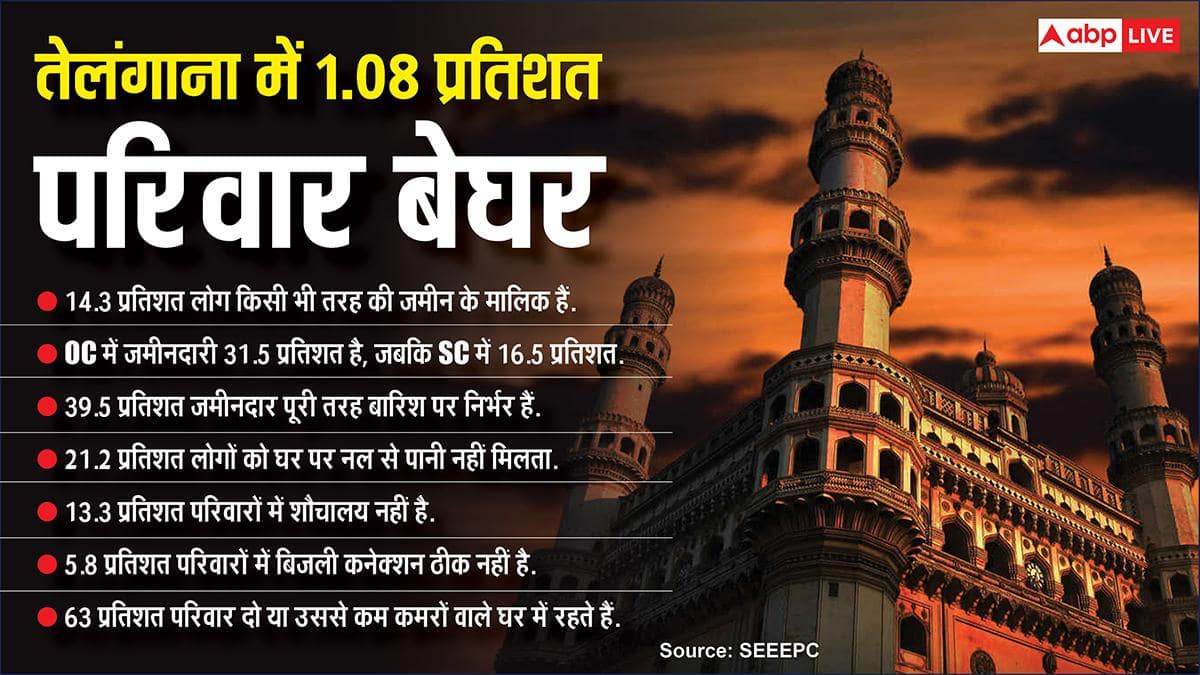
Question 7: What is the role of women, inter-caste marriage and other social aspects?
answer: 25.1 percent of the families in the state are headed by women, especially in rural areas. Inter-caste marriages have taken place in 5.6 percent of the families. In 94.3 percent of the families, members have complete freedom to go to temple, mosque or church. 47.8 percent people have caste certificate, which includes ST (59.9 percent), SC (61.5 percent) and OC (24.5 percent). The migration rate is only 1.1 percent, but in some districts there are more people going abroad.
Question 8: What is the government going to do with these results now?
answer: Telangana Deputy Chief Minister Bhatti Vikramarka Mallu and Backward Classes Welfare Minister Ponam Prabhakar said education, employment and need-based special schemes would be made for 135 backward castes and sub-castes. Help will be given after seeing the real needs of every family so that true social justice can be achieved. It is clear in the report that the benefits of welfare schemes will now be distributed in a better way keeping in mind caste-based backwardness.
Experts say that this survey is a big achievement not only for Telangana but for the entire country. This shows that caste is still a major cause of socio-economic inequality, but it is entirely possible to change it with the right data and the right policies.