Caste has always been the biggest factor in the politics of Bihar. Since independence, 24 people have become Chief Ministers in the state. In the first 37 years i.e. 1947-1984, upper caste (upper caste) castes dominated. Among them, there were 12 Chief Ministers from classes like Brahmin, Bhumihar, Rajput and Kayastha, who held power for a total of 37 years and 197 days. Among these, Shri Krishna Singh (Bhumihar) ruled the longest for 17 years and 52 days. After this, there was talk of Backward Class (OBC) and Extremely Backward Class (EBC), but nothing came in the bag of Extremely Backward Class. So how long will this caste have to wait to come to power? Know in the explainer…
Question 1: When did the wave of backward and extremely backward classes start in Bihar?
answer: After 1990, Mandal Commission and the wave of social justice came. The era of Backward Classes (OBC) and Extremely Backward (EBC) started. In the last 35 years and 89 days, there have been 7 Chief Ministers from OBC and EBC category, among whom Lalu Prasad Yadav (Yadav), Rabri Devi (Yadav), Nitish Kumar (Kurmi) and Karpoori Thakur (EBC) are prominent. Overall, OBC and EBC ruled for 35 years and 89 days, but the interesting thing is that Karpoori Thakur from EBC i.e. Extremely Backward Class became the Chief Minister only twice (1970-71 and 1977-79), and that too for a short tenure. Three CMs were made from Dalits (SC), but none lasted even for a year.

Question 2: What is the difference between OBC and EBC in Bihar and what is the number of EBC?
answer: According to the Bihar Caste Survey of 2023, the total OBC in Bihar is 63%, of which EBC (Extreme Backward) is 36% and Upper OBC (Yadav, Kurmi, Kushwaha etc.) is about 27%. 112 castes are included in EBC. These include Dhanuk, Hajjam, Kahar, Mallah, Nishad and Teli etc. Among them there are also 24 Muslim EBC (Pasmanda). These 112 castes are small, there is no one with big leadership. EBC is the largest group in the total population, but their share in the assembly never went above 10%. It is scattered. No single leader or party could take them completely under their control.
The caste survey of Bihar says that upper OBC castes like Yadav 14.26%, Kushwaha 4.21% and Kurmi 2.87% are small in number but organized. This is the core vote bank of RJD (Yadav) and JDU/BJP (Kurmi-Kushwaha). EBC is 36%, but due to being divided into 112 castes, no single face has emerged. All parties kept working to get EBC votes by creating reservation, Mahadalit scheme and EBC commission at the Panchayat level, but the post of Chief Minister was always given to the upper OBC or upper caste. Nitish Kumar created EBC Commission in 2005, gave 20% EBC reservation in Panchayats and created Mahadalit category, but kept the post of CM himself for Kurmi i.e. upper OBC.
Question 3: What was the role of EBC in the politics of Bihar in 36 years?
answer: OBC dominated in Bihar from 1990 to 2026. Lalu-Rabri’s Yadav rule lasted for 14 years. Nitish Kumar’s Kurmi rule lasted for 19 years and 231 days. In the 2025 assembly elections, NDA (BJP-JDU) won 202 seats. Nitish again became CM, but in March 2026 he decided to go to Rajya Sabha and took oath on 10 April 2026. On 15 April 2026, Samrat Chaudhary (Kushwaha) became the new Chief Minister of Bihar. Who is also the first CM of Bihar of BJP.
That means first upper caste, then Yadav, then Kurmi and now Kurmi’s brother Kushwaha. EBC number has still not come. Due to scattered EBC, parties use them as vote bank, but give preference to upper OBC on top posts. BJP also kept EBC faces like Prem Kumar (Kahar) or Sanjeev Chaurasia in discussion, but chose Samrat Chaudhary (Kushwaha).
Question 4: How long will EBC have to wait to get its political rights?
answer: The number of EBC is high, but there is a lack of organization and united leadership. 112 castes fight on different issues. No EBC leader like Karpoori Thakur has yet emerged who can unite the entire class. All parties RJD, JDU and BJP keep EBC happy by giving them Panchayat and ministerial posts, but give priority to castes with strong vote banks like Yadav, Kurmi or Kushwaha for the post of CM. Even after Nitish in 2025 elections and 2026, EBC was kept only as an ally.
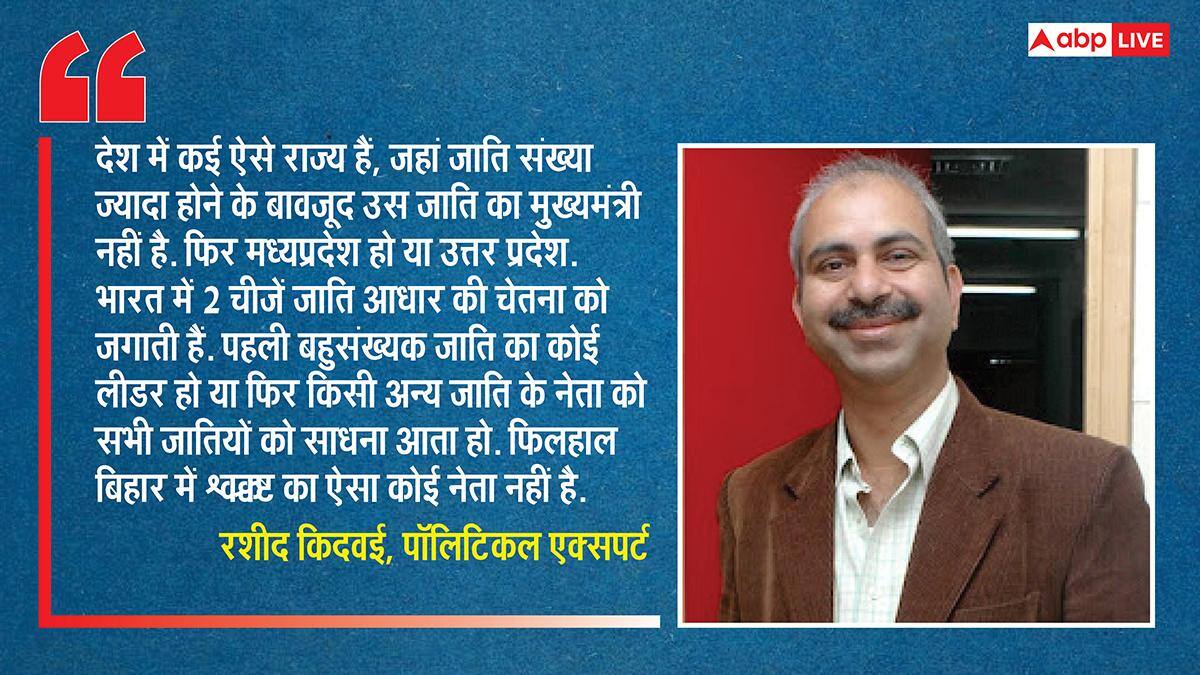
Political expert Rashid Kidwai says, ‘Right now the triangle of Yadav-Kushwaha-Kurmi is strong in power in Bihar. For EBC to get its rights, either a new EBC face will have to emerge or a platform for all 112 castes will have to be formed. At present the wait continues. The politics of Bihar has been in the hands of OBC for 36 years, but EBC is still far from the pinnacle of power. The caste survey proved the numbers of EBC, but the mathematics of power is still in favor of the upper OBC.