4 people have died due to cloudburst in Dharhali of Uttarakhand. Dharali village of Uttarkashi suddenly flooded after a cloudburst on Tuesday (August 5), due to which many people are still missing. Now an exclusive picture of the causes of this disaster has come out. In Bhutan PHP-1 Senior Geologist Imran Khan has shared pictures of that Gelsier Deposit Slide.
Geologist Imran Khan said that about 7 km above Dharali village, located at an altitude of about 6,700 meters above sea level, Glacier deposit The debris was rapidly downwards towards the valley due to a large part of the debris. According to the satellite image, the thickness of the glacier rubble is 300 meters and the regional expansion is about 1.12 square kilometers, due to which there is havoc in the low -lying areas.
Why the destruction in Dharali, the reason came out
The real reasons behind the horrific disaster on August 5 in Uttarkashi Dharali, Uttarakhand have been revealed by the shared photos of senior geologist Imran Khan. Imran Khan running in Bhutan PhPA-1 Work in He has shared a photo on social media, through which detailed information about the incident in Dharli has been given. It also includes many technical aspects.
About 7 km above Dharali village, an important group of coarse fox deposits made of glaciers, located at an altitude of about 6,700 meters above sea level, has been found. These deposits are approximate vertical thickness 300 meters. Its regional expansion is 1.12 sq km. Its composition is of the estimated snow and glacier-substance.
Debris reached the village in less than a minute
During the cloudburst on Tuesday (August 5) in Dharli, heavy rains and strong flow of water suddenly slipped the glazed debris. The slope standing in the way of the drain further increased the speed of debris. It extends about 7 km. At a high speed, the debris reached Dharali village in less than a minute, which caused a lot of damage.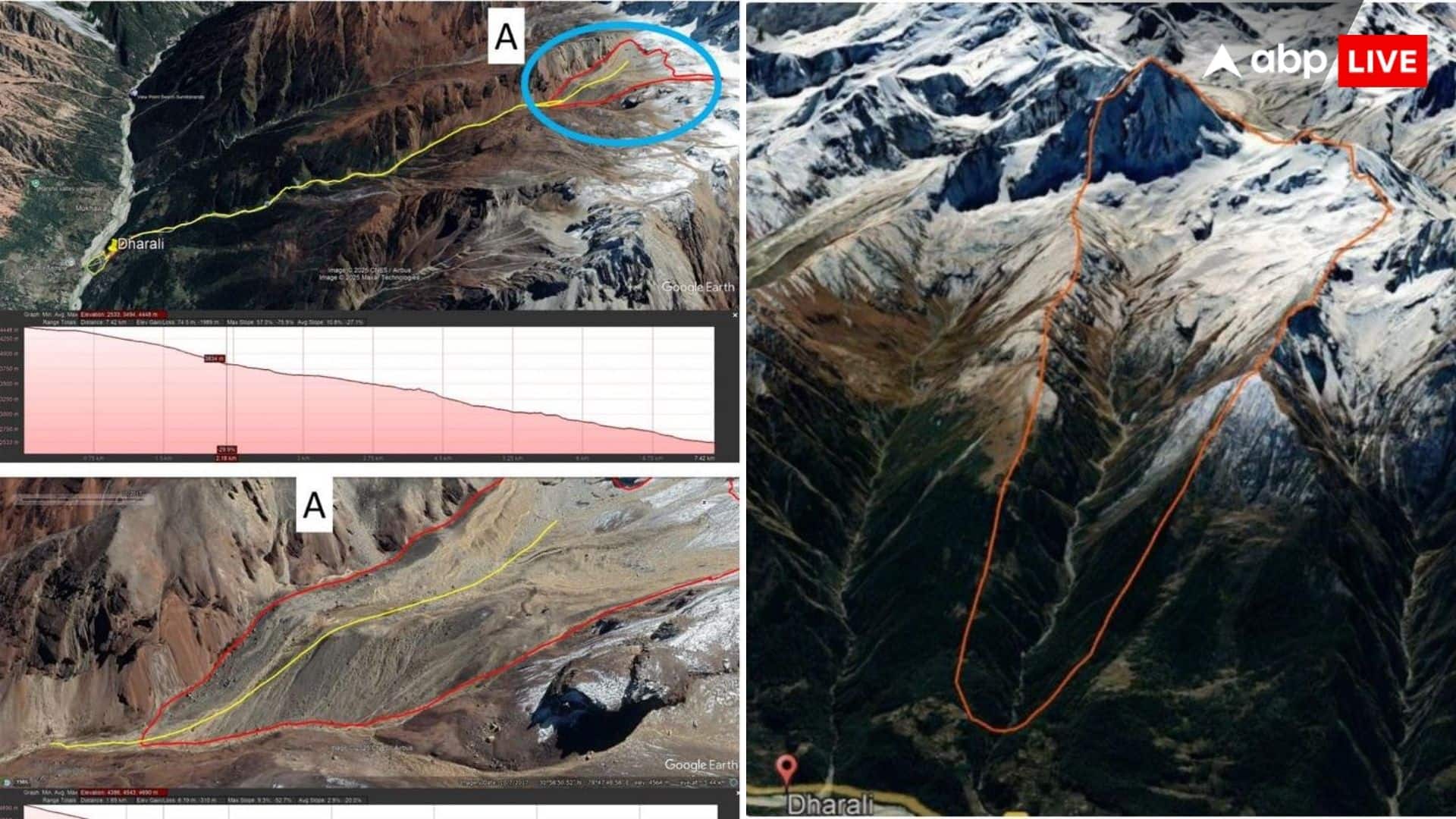
What is glacier deposit
Glacier deposits are the material deposited through the glaciers. It contains large pieces of ice. These pieces slowly move downwards due to gravity. They also collect debris like rocks, gravel, sand and soil on the way. They move forward with them. When the glacier melts, it leaves behind the debris brought with it, which is called Glassial Deposit.